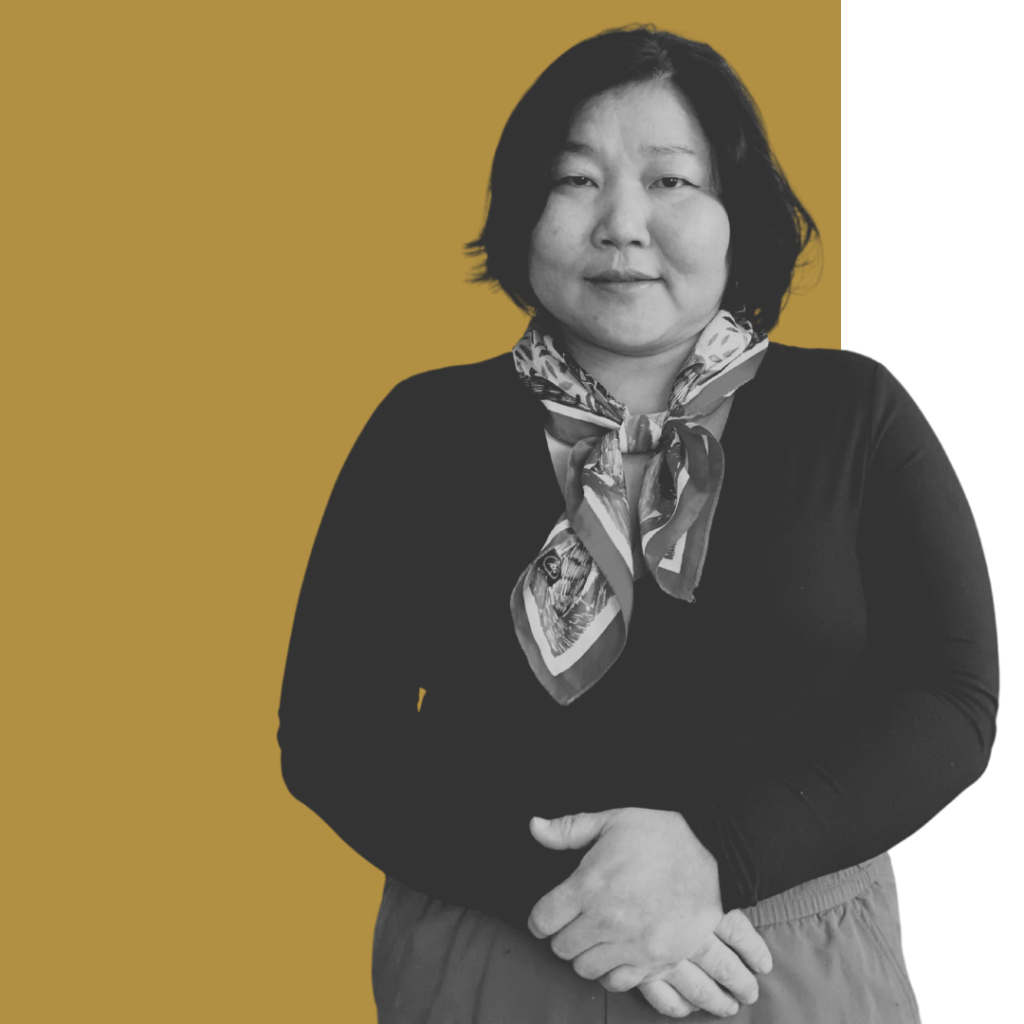
| Exhibiting Name | Soyolmaa Davaakhuu |
| Birth Year | 1977 |
| Country of Origin | Mongolia |
| Current Base | Ulaanbaatar, Mongolia |
| Primary Discipline | Painting · Mixed Media |
| Medium / Materials | Acrylic · Oil painting · Silk painting · Appliqué · Embroidery |
| Career Stage | Established |
| Years Active | From 1998 to present |
| Education (key) | Bachelor of Fine Art in Mural and Architectural Painting (referred to as Monumental Painting), The School of Fine Art (est.1945), Ulaanbaatar, 1998 |
| Memberships | Full member since 2001, Union of Mongolian Artists (UMA); UMA is affiliated with the International Association of Art (IAA WORLD), a UNESCO-affiliated global body for visual artists |
| Gallery / Representation | Independent, Commercial contract with “Dakhini as Art” |
| Solo Exhibitions | 12 |
| Group Exhibitions | 23 |
| Social Media | Instagram |
| Open to Opportunities | Gallery Representation · Exhibition · Collection · International Art Residency · Research |
| Contact Email | soyolmaa.artist@gmail.com |
ARTIST BIOGRAPHY
Soyolmaa Davaakhuu (b. 1977, Mongolia) is an established contemporary artist based in Ulaanbaatar, with a career spanning over twenty-five years. Raised in an artistic family, she was introduced to art early in life and later pursued formal studies at the Institute of Fine Arts (now the Mongolian Academy of Fine Arts) from 1993 to 1998. She has been a full member of the Union of Mongolian Artists since 2001.
Soyolmaa’s artistic practice is deeply informed by Buddhist philosophy, ritual, and symbolism, yet it deviates from conventional iconographic traditions. Her paintings often depict contemplative female figures inspired by Buddhist sky goddesses known as dakinis, who embody transformative wisdom and spiritual energy, characterised by subtle strength and quiet introspection. These figures are positioned outside specific temporal or cultural frameworks, offering a humanised and contemporary interpretation of spiritual themes. Art historian Dr Uranchimeg Tsultemin analysed her paintings extensively in a 2017 journal article, highlighting Soyolmaa’s ability to reinterpret dakinis and other sacred subjects through everyday embodiment, free from traditional aesthetic constraints.
In the decade that followed, the artist sought to push the boundaries further, focusing on concepts of inner life and ego transformation, which led to more visual abstraction. Since 2021, she has incorporated found objects into her compositions, extending her practice beyond traditional pictorial conventions. This cycle was strongly shaped by the pandemic years; especially after moving to a larger studio, she began freeing herself from the burdens of context and physical limitations.
Soyolmaa utilises a wide array of media, including acrylic, oil, silk painting, appliqué, and embroidery, and continues to expand her material repertoire. Her work has been exhibited internationally, with 12 solo exhibitions and 23 group exhibitions across Asia, Europe, and North America. In 2006, she served as an artist-in-residence at the Oglethorpe University Museum of Art in Atlanta, contributing to the exhibition “Portals to Shangri-La: Masterpieces from Buddhist Mongolia.”
CURATORIAL STATEMENT
Soyolmaa has sustained a remarkably consistent painting practice for over twenty-five years through Mongolia’s turbulent transition from communism to democracy. Widely regarded as one of Mongolia’s leading contemporary artists, her work continues to deserve far greater international recognition.
In Soyolmaa’s work, Buddhism functions less as a source of iconography and more as an embodied methodology: a means of inhabiting experience, directing attention, and redefining the relationship between the visible and the invisible. Rather than replicating canonical thangka compositions, she employs Buddhist deities and narratives as a conceptual framework to investigate presence, emptiness, and the permeable boundaries between the sacred and the everyday. Her recurring engagement with dakini (Skt. ḍākinī, ‘sky-goer’ or ‘sky dancer’) (Watt 2011; Himalayan Art Resources 2011) serves not as devotional illustration but as a visual translation of reflective states such as meditation, repetition, and non-attachment.
Her art has been the subject of extensive research by art historian Dr Uranchimeg Tsultemin, who, in a 2017 journal article on the post‑socialist revival of Buddhist art in Mongolia, asks what it means to reanimate Buddhist imagery within a contemporary social context. Tsultemin argues that Soyolmaa’s humanised, personalised portrayals of dakinis and other sacred figures moved away from canonical models, yet open up fertile ground for rethinking how Buddhist philosophy can be visually articulated and made accessible to wider audiences today.
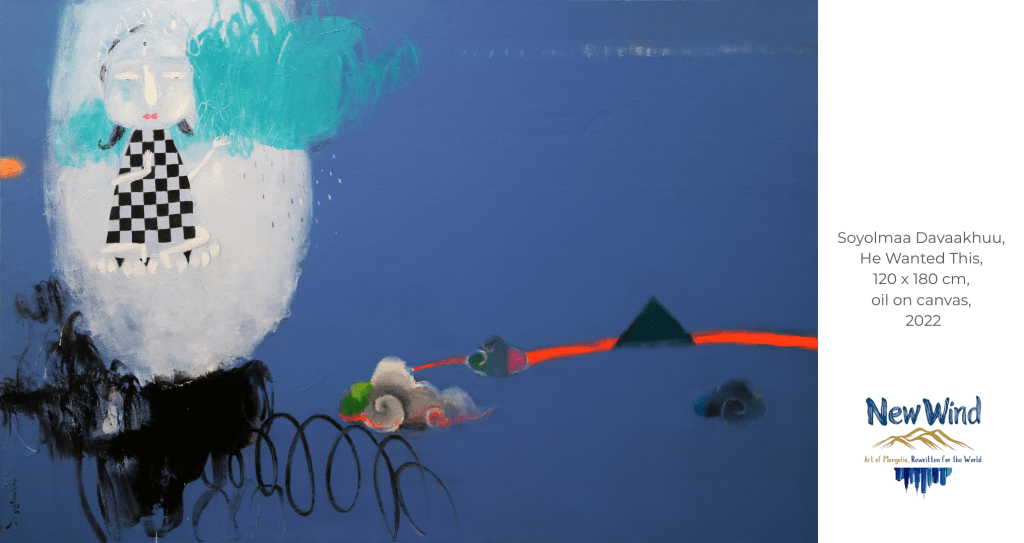
Over the last decade, including the pandemic, Soyolmaa’s practice underwent a significant transformation. The acquisition of a larger studio provided her with the opportunity for self-discovery, a process reflected in the painting “He Wanted This” (2022). She said she wanted to make her rebirth the central theme of the work, aiming to express it with greater lightness and ease. The lockdowns provided a period of reflection, which she translated into visual form through dots and lines, with the third eye symbolising a new awareness. As she completed the painting, her younger brother entered, remarked, ‘This is what I wanted from you,’ and requested that the painting be titled accordingly.
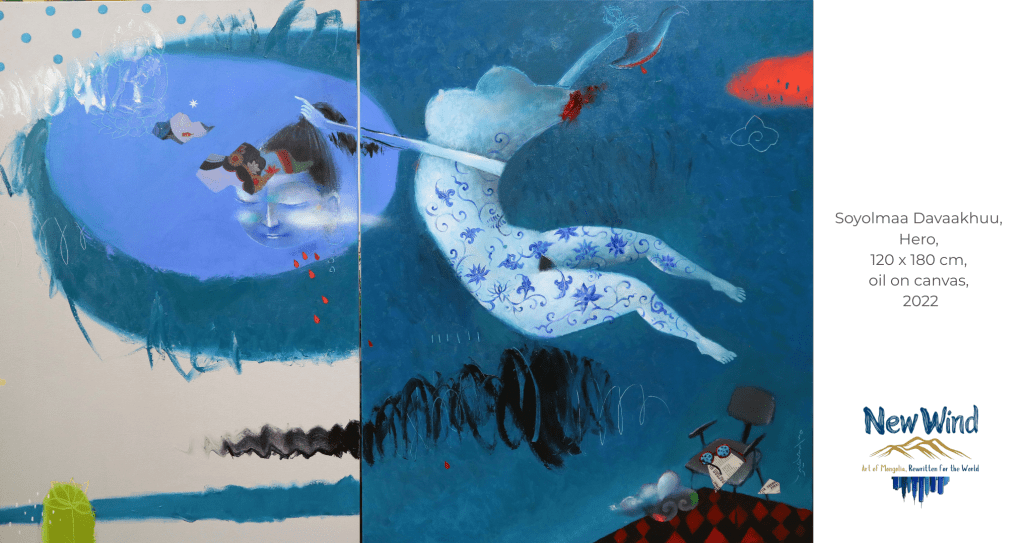
In “Hero” (2022), a wrathful female dharma‑protector, called Хажид (Nar Khajid in Mongolian Buddhism), holds a sword and her own head. The work suggests that, although life is brief, there are innumerable opportunities for ongoing self-discovery. Despite presenting it as a human, the concept remains the same: the necessity of continually cutting our ego and reaching total freedom without the Self. The figure is drawn like porcelain to convey the vulnerability and fragility of the physical body, which can break or evaporate at any moment. Even if the portrayal appears violent, it is a generous act.
“Untitled” (2023) represents Soyolmaa’s most abstract work to date, marking a significant departure from her earlier reliance on depictions of Buddhist subjects and narratives. This work aligns more closely with both the current state of Mongolian society and the artist’s own search for authenticity. But she is not looking to add a hint of grey to a struggling democracy; rather, she disrupts the gloomy outlook by consciously seeking hope and light for a better future. That is an act of quiet resistance without protesting, screaming or performing “activism” to attract more eyeballs. She finds it stimulating to engage both the harsh reality and her meditations simultaneously, exploring the deep contrasts and ways to bridge between the two.
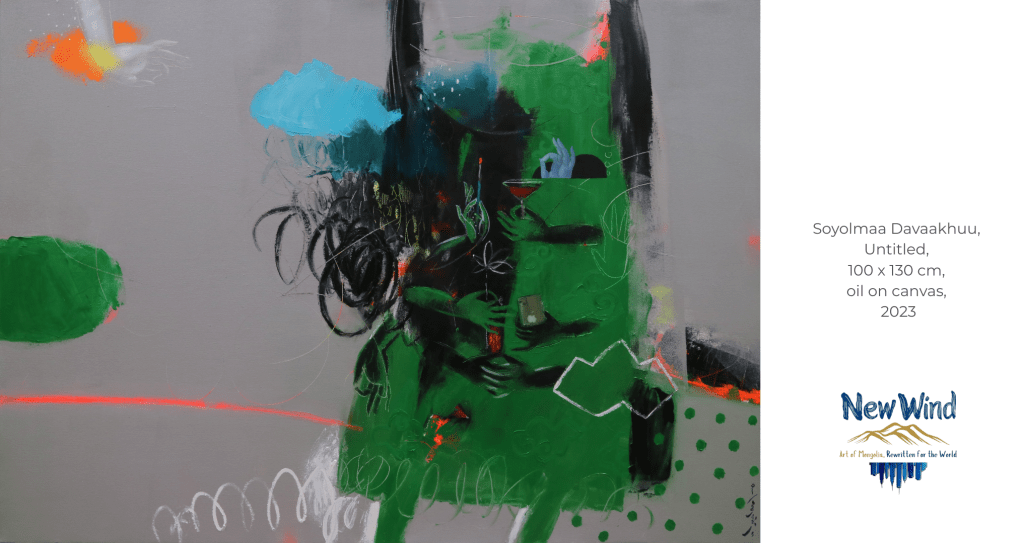
Soyolmaa is moving towards abstraction through natural progression and attempting to visualise what cannot be seen. How do you visualise an “emptiness”, a concept everyone understands differently? For that, she continues her work not only as a “Mongolian” artist but also as a meditation practitioner, a keen observer of life, and a prolific artist.
Dr Tsendpurev Tsegmid
2026.06.01
References
Archival discussion with the artist, 2026, New Wind Mongolia Archive, 10 March.
Tsultemin, U. (2017) ‘Buddhist revelations in Davaakhuugin Soyolmaa’s contemporary Mongolian art’, Cross-Currents: East Asian History and Culture Review, (25), pp. 199–224 (private PDF copy provided by the artist).
Watt, J. 2011, Subject: Dakini – witches, spirits & deities, Himalayan Art Resources, viewed 31 May 2026, <https://www.himalayanart.org/search/set.cfm?setID=2603>
About Artist Inquiries
New Wind Mongolia documents contemporary Mongolian artists through original research and curatorial writing. Each artist profile includes their direct contact information.
New Wind is a research platform, not a representation or liaison service. All inquiries regarding exhibitions, collaborations, or opportunities should be directed to the artist.
Copyright
©2026, Soyolmaa Davaakhuu & New Wind, Art of Mongolia, Rewritten for the World. All rights reserved. Please do not copy or republish on a different platform without the author’s permission. If the use is for educational purposes, please credit our archive as the source.
This entry has been updated on 2026.06.01. The next update is due on 2029.06.01.
 New Wind: Art of Mongolia, Rewritten for the World